How Does an MS in Chemistry Open Doors to Environmental Careers?
Skills learned become tools needed to solve urgent ecological problems
Key Highlights
- Explore how a Master of Science in chemistry leads to careers in environmental science and other chemical fields
- Climate-focused chemists connect advanced research with environmental innovations
- Discover why skilled environmental chemists are needed to tackle global challenges
- Chemistry is a lot more than just a subject you take in school. It’s a branch of science that is crucial to our daily lives.
From the food we eat to the car we drive, chemistry explains how things work and how we interact with the world around us. Specifically, chemists study matter—from its building blocks to its reactions with other substances. They help to ensure the medicine you take is safe and the technology you use works.
Chemistry is a broad field, so there are many careers to consider. One of those is an environmental chemist. You’ll be at the center of studying complex issues and developing real-world fixes. Whether it’s inventing cleaner energy or designing better systems to keep drinking water safe, you’ll lead the way to a more sustainable future.
Start shaping a cleaner, smarter future Explore how an MS in Chemistry will help you create a healthier world
Apply Now!When you earn a master’s in chemistry, you gain specialized knowledge and advanced training to make you more effective and productive in the field. This degree will help open doors to environmental consulting, government and industry jobs and help you lead the charge toward a more sustainable future.
What do environmental chemists do?
Environmental chemists use their knowledge of how chemicals interact with the natural world to study how contaminants affect ecosystems and human health. A master’s degree in chemistry gives you the analytical skills to focus on air, soil and water and guide policy or develop new technologies to reduce pollutants and protect these critical resources.
With your analytical skills, technical expertise and comprehensive understanding of your field, you’ll be at the forefront of driving innovation and creating real-world results.
How can environmental chemists reduce pollution?
Whether you are talking about air pollution, contaminated water or public health threats, environmental scientists have the skills to monitor potential threats and resolve them.
When it comes to air pollution, environmental chemists can analyze the level of smog in the air and provide guidance on reducing the emission of pollutants to create healthier air. You might work with regulatory agencies and industry partners, developing emission-reduction technologies or creating air-quality models to predict pollution. As a researcher, you could inform policies that reduce health risks.
We all need clean water to live, which is why the work of environmental chemists is critical. By knowing how to identify and study how pollutants such as heavy metals, microplastics, pesticides and pharmaceuticals move through waterways, chemists work on ways to detect these contaminants and create tools to remove them. Your expertise will be key to designing cleaning systems that keep water safe and accessible to communities around the world.
We’ve all seen the news stories when a community is rocked by an environmental accident or catastrophe. Among the initial responders are chemists who can assess the damage and design ways to clean it up. With their knowledge of chemical interactions, they could develop ways to neutralize pollutants or use natural techniques, such as microorganisms, to clear hazardous material. Their remediation work helps to restore ecosystems, protect biodiversity and get communities up and running after these events.
How can environmental chemists help tackle climate change?
For decades, chemists have been working on developing sustainable materials and carbon-capture initiatives, along with renewable energy solutions. Through research, they study ways to slow climate change, reveal the links between human activities and environmental changes, inform public policy on cleaner energy systems and provide a range of industries with scientific basis to change production methods or support innovation.
How can an MS in chemistry lead to a career in sustainability?
A Master of Science in chemistry provides a strong foundation for tackling sustainability challenges and driving change within science-based careers.
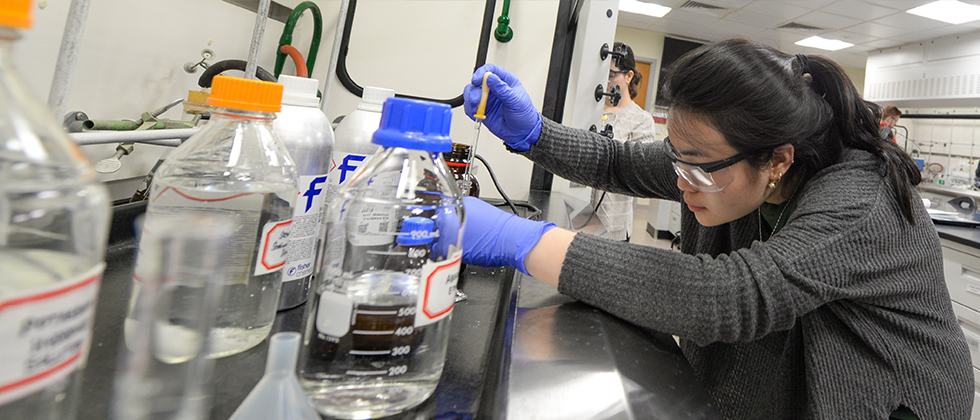
Graduate-level study at Sacred Heart University provides you with advanced training in bench chemistry and computational methods, giving you the skills to design experiments, analyze chemical systems, build databases, create algorithms and apply modeling to solve complex chemical and biological problems. You can also explore advanced chemical and bioanalytical methods and techniques through hands-on lab experience, which builds the skills essential for tackling real-world environmental challenges.
The skills you learn with your MS in chemistry can take you into:
- Environmental consulting, advising clients on compliance and cleanup strategies
- Federal and state government laboratories, conducting research and developing regulations to protect public health
- Industry laboratories, developing more sustainable products or manufacturing practices
- Research and academia, providing the public and academic colleagues in industry with data to advance renewable energy initiatives, track contaminants or develop and manufacture more sustainable materials
Interested in earning an MS in chemistry?
Environmental chemistry is more than an academic discipline—it’s a science that can lead to a healthier planet. Your scientific insight can lead to positive change for communities around the world.
SHU’s MS in chemistry program provides options designed to meet students’ academic, professional and personal interests. The program works to provide a chemistry master’s for working professionals, with flexible, full-time and part-time options to fit your schedule. Most classes take place on weekday evenings, so you can continue working while earning your degree. And you don’t have to earn a bachelor’s degree in chemistry to earn an MS in chemistry. If you have background knowledge in chemistry, you have the potential to succeed in the master’s-level classes.
If you are interested in teaming your bachelor’s and master’s degrees, SHU offers a bachelor’s-master of science in chemistry 4+1 dual degree program, which allows first-year students to be admitted into the graduate program at the same time as their admission to the undergraduate program. Students can also apply for the master’s program while already enrolled in the bachelor’s in chemistry program.
For more information about these programs, schedule an appointment with Whitney Kolwicz, director of graduate admissions & recruitment, or contact program director Linda Farber at farberl@sacredheart.edu.
Want to hear more from SHU? Subscribe to our Pioneer Times newsletter to get the latest updates delivered right to your inbox.