What are the Best Master’s Degrees for Math Majors?
Your mathematics degree built a foundation of skills that transfers to a variety of programs
Key Highlights
- Best master’s degrees for math majors include business analytics & applied AI, MBA, computer science, cybersecurity, industrial/organizational psychology and finance
- Math majors develop quantitative reasoning, statistical modeling and logical problem-solving skills that translate directly into graduate study
- STEM-focused graduate programs prepare math majors for careers in data analytics, artificial intelligence, financial analysis and information security
- Sacred Heart University offers career-aligned master’s degrees that build on mathematical training and analytical thinking
- Graduate education helps math majors expand into leadership, technology and finance-driven industries
You’ve solved complex equations, worked through proofs and learned how to approach problems methodically. So, what’s next after earning your math degree? Being a math major is one of the most versatile, high-impact degrees you can earn. In a world driven by data, technology and strategic decision-making, your ability to analyze patterns, interpret quantitative information and think logically is essential.
Whether you’re interested in business leadership, financial markets, computer systems or applied analytics, your skills as a math major are highly transferable. Here are some graduate degree programs at Sacred Heart University designed to build on your strengths in quantitative reasoning, modeling and analysis.
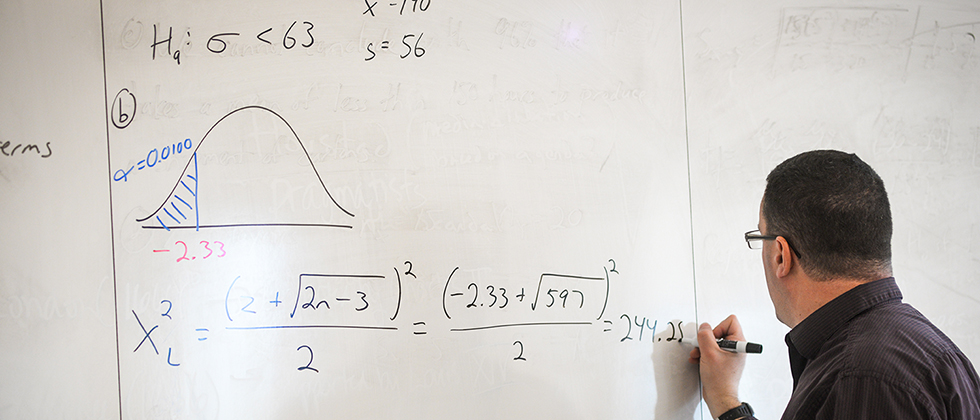
That math degree helped you become a precise, analytical thinker. Now take those skills into the future.
Find a ProgramMaster of Science in Business Analytics & Applied AI
If you enjoy working with data and uncovering insights, a master’s in business analytics & applied AI allows you to apply statistical modeling and predictive analysis to real-world business challenges. Math majors are well prepared for coursework in analytics, machine learning foundations and data-driven strategy, making this program a natural next step.
Master of Business Administration (MBA)
If you want to pair your quantitative expertise with leadership skills, an MBA can expand your career opportunities. Math majors often excel in finance, operations and data-informed decision-making. This degree prepares you for management roles where analytical thinking and strategic planning drive organizational success.
Master of Science in Computer Science & Information Technology
Mathematics and computer science share a strong foundation in logic and problem-solving. A master’s in computer science & information technology builds on your background in algorithms and structured thinking while preparing you for careers in software development, systems analysis and emerging technologies.
Master of Science in Cybersecurity
If you are interested in protecting digital systems and sensitive information, a master’s in cybersecurity offers a path into a rapidly growing field. Concepts such as cryptography, risk assessment and network security rely heavily on logical reasoning and quantitative analysis, areas where math majors thrive.
Master of Science in Finance & Investment Management
For math majors drawn to financial markets and economic strategy, a master’s in finance & investment management provides advanced training in portfolio analysis, financial modeling and risk management. Your background in statistics and quantitative reasoning gives you a competitive edge in investment and financial analysis roles.
Master of Science in Industrial/Organizational Psychology
If you are interested in applying statistics to workplace performance and organizational effectiveness, a master’s in industrial/organizational psychology offers a data-driven approach to understanding human behavior at work. This program emphasizes research design, quantitative analysis and measurement, allowing math majors to apply their statistical knowledge in business and organizational settings.
What Graduate Degree Should a Math Major Choose?
The best graduate degree depends on how you want to apply your mathematical skills:
- Choose business analytics & applied AI if you want to work with data and machine learning
- Choose an MBA if you want leadership roles that require quantitative decision-making
- Choose computer science if you enjoy coding and algorithms
- Choose cybersecurity if you are interested in encryption and digital protection
- Choose finance if you want to work in investment or risk analysis
- Choose industrial/organizational psychology if you prefer research and applied statistics in workplace settings
Each of these programs allows math majors to build on their strengths while expanding career possibilities.
Whether you’re leading data-driven initiatives in business, developing secure technology systems, analyzing financial markets or applying advanced analytics to complex problems, Sacred Heart University offers graduate programs that help you turn mathematical skill into meaningful, career-focused impact. Your degree isn’t narrow. It’s powerful.
Ready to transform your future?
To learn more about Sacred Heart’s graduate programs, schedule a meeting with Ed Nassr or reach out at nassre@sacredheart.edu or 203-396-6877.